Showing posts with label Gary Neville. Show all posts

Monday, 15 September 2014

Book Review - RED: My Autobiography by Gary Neville

The season is back, and with it, comes Monday Night Football. The ultimate indulgence for those who consider football with an air of intelligence in debate. With two absolute footballing heavyweights - in the form of Liverpool and Manchester United legends Jamie Carragher and Gary Neville, sitting on the panel, the Sky punditry line up is probably the best in world football right now. 

Football analysis and punditry was getting very stale by the time Sky Sports picked up the two former England defenders. Almost to the point where Brian Clough’s famous interview with John Motson had become absolutely relevant again (watch here). Match of the Day has become one of the most boring shows on TV, and let’s not even mention the standard of analysis/coverage on The Football League show.

In taking on Carra and G. Nev, Sky Sports have added modern top level experience to their line-up, which already boasts the brilliance of Graeme Souness, Jamie Redknapp and Glenn Hoddle, taking football broadcasting to a whole new stratosphere.

This is particularly interesting in the case of Gary Neville. He has gone from being one of the most hated men in English football to one of the most respected and adored. From “Gary The Rat” and “Red Nev”, to one of the most intelligent and intriguing analysts of the game we have yet been subjected to.

Best mates
Shortly before his debut on Sky, Neville brought out his autobiography; Red - which is the focus of this article. The debut of this book was categorically the turning point for G. Nev. and his reputation amongst English fans who had previously held the former United captain with disdain.

Neville speaks to us with the frankness and intelligence that we have since become accustomed to. Although, let me announce from the off that in the build up to this post I have read several other reviews, whereby I mainly concerned myself with the poor ones - of which there are very few. The general disappointment stems from the lack of personal life that is revealed throughout. 

But they've missed the point. For Gary Neville, football is life, and this book oozes that fact. Do not read this book if you are concerned with the birth of his children, his wedding, his home... (you get the picture), as you will ultimately not find what you are looking for. If you are however interested in the inner mentality of a winner, a man obsessed with football, and in particular Manchester United, the emotion of the game on the pitch, and maybe just a bit of insight into what life under Sir Alex Ferguson was really like, then go out and pick up this book immediately.

From the FA Youth Cup winning side of '92, to deciding to retire mid-game against West Brom, Neville takes us on a detailed account of his time as a Red, kicking off with tales of his upbringing into a working class family in Bury (which happened to yield three international athletes). We are taken inside his school playground and how life was growing up standing in the K-Stand (Old Trafford's East Stand) under the shadow of Liverpool, as well as the inescapable bust-ups with supporters of United's famous rivals. Indeed, Liverpool play a huge role throughout the book, as they undoubtably have throughout Neville's sporting life.


"As a kid, I had to suffer at their hands again and again. But that’s why every victory later in life tasted so sweet. That’s why I charged up and down the pitch celebrating every win over Liverpool. It’s why I kissed the United badge in front of them, like any true fan" 

"Now I am able to appreciate Liverpool as another true working city of the north. I can recognise the loyalty of their supporters and admire how Liverpool, like Manchester, has punched above its weight when it comes to music and football. But back then I loathed Liverpool and I loathed their success"


Fergie's Fledgelings - Then and now
Neville gives us a stark insight into what life was like growing up as part of the famed "Fergie's Fledgelings" - the hard work and commitment that was required, and of course the unenviable initiations that the apprentices were put through - often at the hands of a certain Welsh winger. Neville puts us under no illusion that it was never his footballing talent that got him where he was, very much demonstrating the type of steel that was needed to just be a part of Manchester United under SAF. 

What is starkly apparent is the sheer aggression and fierceness with which United conducted business from top to bottom in the early 90's. Fergie comes across every bit as ruthless as we imagine him to be, with youth coach Eric Harrison coming up not far behind. Second place was most certainly the first loser.

Aside from the seriousness of on-pitch affairs, we also gain priceless stories behind the "kids" who rose from humble beginnings at The Cliff to defeat the world of football and go on to win countless trophies. The book works very well as an accompaniment to the recent cinema release "The Class of '92" in this sense.


"There are a few moments you look back on - those cross-roads moments - and wonder how life might have played out differently. I wasn’t nailed on to be a professional footballer. I knew that."


Notable sections in the book also include the relationship between David Beckham and the boss, the England players' 'almost-strike' following Rio Ferdinand's drug-test ban, the treatment that Beckham received along with brother Phil from England fans following errors in the national shirt, being shit-scared of Peter Schmeichel, and of course his disappointing time in an England shirt, with some mention of the methods employed by now-Sky colleague Glenn Hoddle. 

"What are you meant to do? Smile
sweetly and jog back to the half-way
line?"
Red is a must for any fan of sport. An unflinching account of life at the top of world football, without over-zealous commentary it provides a peek inside one of the most famous/infamous dressing rooms around in a time when both England and Manchester was changing for the better.

I actually had the pleasure of being coached by Gary Neville on more than one occasion, during the time he took his UEFA Coaching Licenses, and what struck me the most about his style of coaching was first of all, he loved to have a laugh, and secondly, that he cared deeply about football as a tactical system, and how the game evolves through certain phases of play - he very much wanted to impress the importance of this on us as players (in fact on one occasion it turned out that he wanted to coach a system whereby the attacking team did so through the wing backs. As the left-sided wing back on the attacking team, he more or less spent a whole hour showing me the in’s and out’s of playing in the role he dominated for nearly two decades. It was brilliant).

It was presented to us and explained in such a way that it made learning easy, and made us thirsty for more tactical insight - and that is exactly what he is doing to the wider public now in his role as Sky pundit. His knowledge of the game is clearly exceptionally strong.

Of course, it was quite a proud moment for us who partook in his sessions when he passed his qualifications, and subsequently went on to enter the England setup under Roy Hodgson.

United celebrate the 1996/97 Premier League title; L to R - Cantona,
Butt, Giggs, Beckham, Phil Neville, Gary Neville, Scholes, Keane.

Bill Shankley famously said: "Football is a simple game, made complicated by idiots”. But in the case of Gary Neville, when the game of football is complicated by men of intelligence who possess a deep understanding of the game, great things can become of it. It is important for the development of footballing intelligence amongst English supporters that Neville remains on our screens for a long time to come, whilst undoubtably providing the England setup with his winning mentality and invaluable insight.

"Being a football supporter has never just been about the team you love. It’s also about the teams you love to hate. English football is brilliant for being so tribal and there’ll always be an edge between United and Liverpool"

8.5/10

nb. I am well aware that this post has probably gone beyond the realms of just a "book review". However, given the sheer influence that Gary Neville now has over English football on both sides of the media/professional football fence, I feel it is more than warranted. 

Enjoy our article? Let us know! If you have any suggestions for further reading material that you would like reviewing or discussing, send us a tweet @LoneStrikerBlog


Friday, 29 August 2014

The New England Revolution


Well, today has certainly been busy in the world of football. Roy Hodgson has both named his squad to face Norway and Switzerland for the upcoming fixtures, and handed Wayne Rooney the Three Lions armband in the same breath. Along with that, the Champions League Group Stage draw is underway as I type. Liverpool have just been paired with Real Madrid - "Tasty" as Daniel Sturridge has just put it on Twitter.

Hodgson’s selections have been general met with discontent, with neither his choice in captain, or his young squad selection, finding much enthusiasm from England supporters. A record low attendance is expected at Wembley for the friendly against Norway.

But should it be that way? With the retirements departures of messrs Gerrard and Lampard - not to mention Ashley Cole, Rio Ferdinand and John Terry in recent years, the England squad has been left painfully thin in the way of experienced on-field leaders. 

Could Roy have realistically opted for anybody other than Wayne Rooney? What were his real options? Let’s take a look..

Joe Hart


The idea of a keeper leading the team out is something that sits uneasy with many footballing people. There have been many iconic keepers throughout time to successfully captain their sides - just look at Gigi Buffon and “Pre-José” Iker Casillas for two shining modern examples.

Hart clearly plays with passion, albeit sometimes allowing his emotions to get the better of him. Despite his No. 1 jersey coming under pressure last season at Manchester City (with a few dodgy TV commercials in the processes), Hart has now experienced two major tournaments with both England and manager Roy Hodgson, giving at least a decent account of himself both in Poland/Ukraine and Brazil. 

During the same period of time, he has won everything you can do, in terms of top-end domestic football in England, including the Premier League twice - taking the competitions “Golden Glove” for three of the last four campaigns.

At age 27, Hart already has enough experience under his belt and has a possible ten or so years left in his career - with many keepers staying on for international duty until they hang up their boots for good. You could even argue that he still hasn’t hit the peak of his goalkeeping career.

Had Joe Hart been picked, he could have provided a stable base for at least the next four major international tournaments from which Hodgson, and any subsequent England managers, could have built this new young team. 

However, when it’s the 85th minute and you are 2-1 down against France, who do you look to drag you kicking and screaming through the shit to urge and inspire his team on? 

Not your keeper, that’s for sure. 

The luxury that modern day Italy and Spain have had in recent years has been in having leaders all over the pitch - willing to do that job as second nature - allowing the goalkeeper to be the perfect figurehead of absolute calmness amidst the chaos. England, as we have been starkly reminded today, do not have that luxury. 

Theoretically, players representing their country should not need their captain to be the driving force that they sometimes can be at club level, but this will no doubt play a large part in the thought process of many when discounting Joe Hart.


Gary Cahill


In Gary Cahill, England have probably one of the world’s most on form defenders over the last couple of seasons, forming an enviable partnership with John Terry. At 28, Cahill is also the same age as new captain, Wazza.

Despite being relatively new to the sharp end of the game (Cahill only joined Chelsea from Bolton in 2012, lifting the Champions League trophy in his first season at the club), Cahill has become an integral cog in the England machine. Under the tutelage of John Terry (arguably the man who should still be England captain himself incidentally), Cahill’s game has certainly gone up a level over the last couple of years. 

His mental game has always been one of cool composure on the field, not often allowing himself to become flustered. It would certainly have been a bold move to hand Cahill the armband, sealing his rapid rise to the top of English football, but it would have shown once again that Hodgson has the balls to make bold choices and back himself. 

Capable of crunching tackles, calmness in possession, and more than an odd goal or two; Cahill would have been the perfect fit to lead the young exciting squad that Hodgson is clearly trying to mould. 

In order to have secured the backing from Hodgson for his captaincy bid, Cahill's performances would have needed to have been supreme. Did his performance in Brazil really stand out so much so that he warrants getting the nod over Wayne Rooney? Perhaps not.


Wayne Rooney


For all Wayne Rooney’s positives points, this decision is quite evidently one that not all fans are happy about. And it’s easy to see why. Rooney is the personification of everything that many people detest about the modern footballer. 

He’s had numerous scandals, both on and off the pitch, and has a terrible temperament at times; picking up a red card for England prior to the Euro 2012 tournament, in a mindless action that meant he missed the first two games of the group stage. He has been caught smoking and partying in the earlier hours of the Manchester night and has, on more than one occasion threatened to leave Manchester United, in an attempt to leverage a new multi-million pound contract - much to the disgust of Sir Alex Ferguson. These actions have safely ensured that Rooney will never be held in the same regard as Best, Charlton, Law, Cantona, Robson, Ronaldo et. al. 

Rooney will never be considered amongst these immortals who’s names are still sang out with love in the Stretford End.

But he works his bollocks off.

On the pitch, there is absolutely no questioning Wayne Rooney’s work rate. He is, in this sense, a shining example of the kind of effort and devotion that is required of an England captain. It has most certainly been a tough couple of seasons for Rooney, with the changing formations of recent times making a traditional No. 10 a difficult fit into the system - something very evident in Brazil. With the coming of RVP to United, he is no longer the main front man - and at the minute they both look to be very much on a sinking ship.

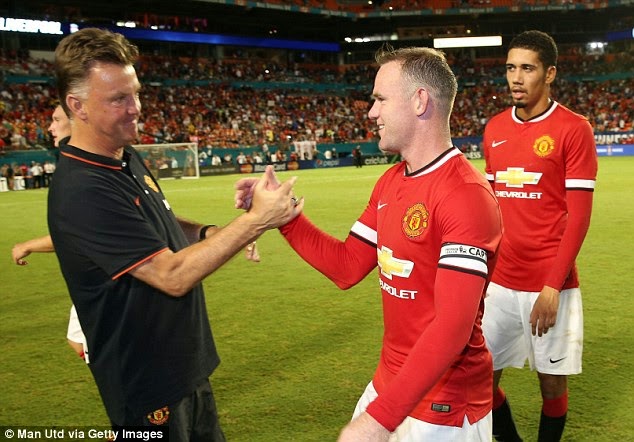
LVG made Rooney Manchester United captain at the start
of the season.
Van Gaal has come into United as the supposed saviour of the club and has in the process, named Wayne Rooney his captain, which might have come as a bit of a nasty surprise to Robin van Persie, who many tipped to be given the honour. However, with their form diabolical in times of late and a mass transitional phase in the offing, Rooney could cut a frustrated figure at Old Trafford for the next few years - if indeed he stays put. Either way, it will certainly be a test of his temperament and maturity.

Rooney has appeared more and more in front of the camera in recent times, becoming the spokesman for the national squad on more than one occasion. He clearly cares deeply about the England side, famously blasting boo-ing fans on TV after the final whistle in Cape Town, following a flat display in a 0-0 against Algeria. 

He is clearly the most experienced man in the side, and in this sense you have to agree with Roy Hodgson that Rooney is indeed “the obvious choice”. During the World Cup in Brazil you could argue that he was barely deserving of his starting slot, and many did - however, this could be put down to the system that Hodgson employed, with Rooney starting out wide on the left flank. 

One thing all England fans will agree on, is that Rooney must now take his game to the next level, both on and off the field, regardless of the position he starts in, if he is to prove himself worthy of  the same title as former legendary England leaders.

It is clear to see why Hodgson has picked Rooney; he is the safe choice. But is he the right one? Time will tell. Hodgson clearly thinks that handing this degree of responsibility, and honour, to Rooney will have a similar effect that it has had elsewhere on some of the world's best strikers, whose international form, like Rooney's, has come under intense criticism. The promotion to captaincy has elevated the performances of Leo Messi, Zlatan Ibrahimovic and Cristiano Ronaldo in recent years. Roy will be hoping for a similar result.

Elsewhere (much) more radical choices could have come in the form of either Jordan Henderson or Jack Wilshere. 

Henderson has shown himself to be of great quality in the centre of the park in the last two major tournaments and has really made the midfield his own; outshining Gerrard comfortably in Brazil. Wilshere, on the other hand, is now likely to gain a few more minutes with Gerrard having retired. Wilshere must earn this spot however. Since bursting onto the stage as a youngster he has yet to solidify his name on the team sheet for both club and country, and this season is probably the most important of his whole career. Injuries cannot be another excuse for Jack. 

Despite this pair looking likely to be our engine-room going forward, they are both fairly unrealistic choices for the captain’s armband, and in this instance, Rooney more than deserves the call over the duo.

The one apparent fact that the instatement of Rooney as captain of both Manchester United and England leaves resonating, is that both club and country are in desperate need of depth and quality. 

The Squad


Goalkeepers; Fraser Forster (Southampton), Ben Foster (West Bromwich Albion), Joe Hart (Manchester City).

Defenders; Leighton Baines (Everton), Gary Cahill (Chelsea), Calum Chambers (Arsenal), Phil Jagielka (Everton), Phil Jones (Manchester United), Danny Rose (Tottenham Hotspur), John Stones (Everton).

Midfielders; Jack Colback (Newcastle United), Fabian Delph (Aston Villa), Jordan Henderson (Liverpool), James Milner (Manchester City), Alex Oxlade-Chamberlain (Arsenal) Raheem Sterling (Liverpool), Andros Townsend (Tottenham Hotspur), Jack Wilshere (Arsenal).

Strikers; Rickie Lambert (Liverpool), Wayne Rooney (Manchester United), Daniel Sturridge (Liverpool), Danny Welbeck (Manchester United).

With the absence of Ross Barkley and Adam Lallana through injury, coupled with the retirement of Lamps and Gerrard, Hodgson hands four players their first England call ups; Jack Colback, Fabian Delph, Calum Chambers, and Danny Rose. It is pretty obvious that had Barkley and Lallana been available then two of these names would not have been on the sheet.

However, in a period of transition it is important that Hodgson introduces competition for positions, and in bringing in four hungry young players he has guaranteed himself men that will give everything they have in training and, given the opportunity, in a match. 

The main question is; do they have the quality? Certainly all four have started the season strongly. Colback has looked outstanding since making the switch from Sunderland to Newcastle, and Calum Chambers presents us with the first genuinely promising young centre-back since Matthew Upson - all those years ago. In Fabian Delph, England have called up Aston Villa's consistent inspirational spark through the middle of the pitch, having had to endure two years of otherwise pretty dull stuff under Paul Lambert. Danny Rose has flirted with call-ups before, but the dynamic youngster falls somewhat victim of type-cast of the modern full-back - that is to say, bags of pace and exciting going forward, but you could probably choose a better defender. I cannot see Rose inspiring us any more than Kieran Gibbs, Luke Shaw, Kyle Naughton, Kyle Walker, Glen Johnson, etc. If anything, we are inundated with average full-backs. 


PS. It is beyond me how George Friend of Middlesbrough has evaded an England call-up thus far. - he's nicknamed "RoboCop" on Teesside for goodness sake! On a serious note, I would actually keep an eye out for him. A serious piece of talent.


Otherwise the squad is not too different from the one we took to South America, save the addition of Andros Townsend, who looked sharp last season before picking up an injury.

England did not look beyond hope in Brazil. 

Baines and Jagielka were indeed found out at international level, but Cahill and Johnson (in parts) were strong. It is here that Hodgson must focus his attentions. The emergence of Calum Chambers and John Stones looks to be a potential solution to England's defensive frailties, whilst Luke Shaw will slot dutifully into left-back, more or less unchallenged. 

Moving up the pitch, England are packed with fast paced, strong tackling, and skilful young talent. A few more months of refinement will not, require too much change, but players like Jack Wilshere and indeed, the new captain are going to have to take their game to the next gear. Competition for places in the midfield and up front will hopefully keep performance high in these areas of the pitch, and leaders will of course be made in time.

One thing is for certain though; despite early career hype, it is looking fairly likely that Phil Jones will never see the England captaincy, but the outlook for England and it's young squad could be a lot brighter than it currently appears to be.


Monday, 16 June 2014

England vs Italy - Match Review: A familiar scoreline, but anything other than 'business as usual'

Aaaannnd breathe. OK, so we've had a couple of day's to let the dust settle in Manaus. We had great feedback from our England vs Italy match preview, so we've decided to give you some light analysis now that we've had chance to take stock of the game, and where it leaves England in regards to Group D. 


England's starting lineup agaisnt Italy on Saturday evening in Manaus


So, England’s first match in Brazil ended in defeat on Saturday night; but the result and England’s performance was anything but ‘business as usual’. For the first time at a major tournament, for well over a decade, England played with a passion, a hunger, and a belief that finally restored a sense of hope and pride amongst England’s long suffering nation of supporters. We here at The Lone Striker believe that's worthy of celebrating. 


The Brains Trust


The Brains Trust

Roy Hodgson has quietly constructed one of them most dynamic management structures that any England coach has ever assembled. Next to long trusted loyal lieutenant Ray Lewington, is the fiery and intensely knowledgeable Gary Neville. Hodgson rules very much through committee rather  than autocratically, and one suspects that the influence of Neville likely swayed Hodgson’s team selection on Saturday evening towards England’s exciting youngsters. Something The Lone Striker feared he wouldn't do, given his reticence to invest his faith in the same group of players in the past.  But ultimately, the buck stops with Hodgson. It takes a certain degree of courage to gamble ‘with the kids’ as Hodgson did against Italy - it’s his job and reputation on the line. His bold, young, attacking lineup was a revelation. There was vindiation too, for his faith in Danny Welbeck, in the face of increasing pressure (including from us) to leave him out of the starting lineup.

Raheem Sterling: A Star Is Born


What became evident just minutes into Saturday’s game was that in Raheem Sterling, England possess one of the most exciting young prospects in world football. Sterling was a constant menace to the Italians who at times had no answer to Sterling’s pace and trickery. Not since Euro 2004 in Portugal have England seen a performance of such sheer fearlessness. A star was born on Saturday night. Let’s just hope that his light burns brighter than those who have come before him.

Danny Welbeck: Faith Repaid


Danny Welbeck was outstanding against The Italians, 
repaying Roy Hodgson's faith in The Manchester United youngster.


Danny Welbeck, the much maligned Manchester United wideman finally repaid the faith of his manager, with his most exceptional performance in an England shirt. Welbeck was relentless in his pursuit to dispossess and pressurise the Italian back line. His tireless performance was a vindication for Hodgson’s refusal to heed calls for Welbeck’s exclusion.

Wayne Rooney: More Frustration for The United Superstar


Rooney cut an increasingly frustrated figure at times against Italy 
It was a mixed night for the under-fire Manchester United star who has come under intense scrutiny, leading up to England’s World Cup. Rooney looked uncomfortable in his starting position on the left of England’s midfield, struggling to grasp his defensive duties, which continually left Leighton Baines exposed and looking vulnerable down England’s left hand side. The Italians all too quickly pounced on this obvious English weakness and clinically continued to target England’s left flank. 

Going forward, Rooney provided England’s superb assist for Sturridge’s goal, and came close to grabbing England’s equaliser in the second half following some superb work to create an opening for himself. 

Ultimately, Rooney needs to do more, and desperately needs a world class performance in order for Hodsgon to continue to justify his place in the starting eleven.  The wolves are at the door for Rooney. With a hungry, and hugely talented Ross Barkley waiting in the wings, and with England’s best player Raheem Sterling excelling in Rooney’s favoured position behind the number 9, Rooney could struggle to finish this tournament as an regular starter.


The Engine Room


The much improved Jordan Henderson continued to impress alongside
 Liverpool teammate Steven Gerrard.
With Italy (predictably) dominating in possession, England struggled to get Steven Gerrard into the game, and for periods, the England captain became a peripheral figure. But in Gerrard’s Liverpool teammate Jordan Henderson, England posses the most improved footballer in the country, over the second half of last season. He looked almost unrecognizable from the player who faced Italy two years ago in Kiev, and it was illustrative that it was Henderson who collared Rooney after The England's equaliser to remind him of his defensive duties - such is his growth in stature inside the England camp.
England again struggled to close down the space around Pirlo the way in which Italy, (the masters of the art) do. But England seemed content to allow Pirlo the time and space to retain the ball deep in Italian territory, knowing that in messrs Sturridge, Welbeck, Sterling and Rooney, England probably possess the most potentially explosive front four of any team at this World Cup - apart from perhaps the Argentineans. 

Apart from Italy’s opening goal - the result of a mass suicidal lapse in concentration, Italy rarely threatened from central midfield areas, and were largely reduced to efforts from distance. This was in large part, due to the industry and discipline of the excellent Henderson, shoring up the space in front of England’s back four throughout.

England's Rear Guard


Glenn Johnson must do more to protect England's centre back pairing
Baines’ vulnerbality down England’s left flank was clearly a cause of concern for Hodgson at the close of the half. In the absence of any effective midfield cover, England started the second half with the excellent Welbeck switched to wide left - but Baines continued to look vulnerable from wide areas, and will rightly feel disappointed that he wasn’t able to close down Candreva’s cross for the (unusually) clinical Balotelli. 

Apart from Cahill being beat by a superb piece of forward movement by Balotelli, ghosting a route to the back post for Italy’s winner, both he and Jagielka looked comfortable throughout. As did  Joe Hart in England’s goal. Despite a nervy start; Hart too, will feel dissaponted that he didn't do better with his old pal's eventual winner.
England must do better to protect the central spine of their back four - which calls upon both Glenn Johnson and Leighton Baines to dominate their respective flanks and to press opposing wide players more aggressively. But these problems are easily rectified in the coming days on England's training pitches.

Goals! Goals! Goals!


Sturridge wheels away after scoring England's superb equalizer
Daniel Sturridge grew in stature throughout the game. An early aversion to gamble in central areas was soon forgiven with a world class finish, after England had carved open Italy in the space of two simple passes - in a way that the Italians singularly failed to do so against the England lineup. 

With England desperately piling forward in the latter stages, the lack of an aerial presence proved a problem. England may have been better served in introducing Rickie Lambert to give them a greater central threat late on, rather than the otherwise impressive Adam Lallana. But critics who called for Andy Carrol's inclusion will point to the fact that the "Geordie Warrior" was excellent against Italy two years ago in Kiev, and the likes of Rooney, Lallana and Sterling were unlikely to win the aerial battles with Chiellini and Barzagli in particular.


The Lone Striker's Verdict


In an almost perverse way, Englands defeat on Saturday night may prove more valuable to this young English squad than a victory would ever have. They were taught valuable lessons at the hands of the Azzurri, that will be of enormous value to these players in this tournament and in tournaments' to come. 

Football at this level is brutally unforgiving, and England were made to pay harshly for two lapses in concentration. But this isn’t any any other tournament, and this isn’t just any other group of England players. 

England have nothing to fear against The Uruguayans this Thursday - even with the return of the mercurial Suarez. On Saturday's showing in Manaus, these are exciting days ahead for Roy Hodgson's new look side.
Strap in an enjoy the ride, it could get bumpy, but one thing is for sure, this could be the start of something very special.


Thursday, 12 June 2014

England vs Italy - Match Preview


After four years of waiting for what feels like an eternity,  the most anticipated World Cup of all time is upon us. This evening, Brazil will kick off the greatest Footballing extravaganza in the history of the game when they play host to Croatia, in Säo Paulo. Finally, the footballing world can breathe a collective sigh of relief - The World Cup is here!

In our latest Post, The Lone Striker previews England’s opening matchup; Saturday night’s ‘Rumble in The Jungle’ against four-time World Cup Winners, the mighty Italy, in Manaus. So what can we expect?


The Azzurri


Expect few surprises from the Azzurri. In Gianluigi Buffon, Italy possess one of the great goalkeepers of all time - at 36 it will probably be the last time that the colossus will captain his country in a World Cup, and thus the last time he will attempt to add to his 2006 winners medal. In front of Buffon, will be his Juventus team mates; the centre-back pairing of Leonardo Bonucci and Giorgio Chiellini. Either side will be Milan duo, Ignazio Abate at right back and Mattia De Sciglio at left back.


Italy Imperious Captain Gianluigi Buffon will be aiming to win his 
second World Cup this summer in Brazil.

In midfield in recent weeks, Cesare Prandelli has experimented with a 4-3-3 formation, but has faced heavy criticism from back home in Italy, concern mounting due to lacklustre performances against The Republic of Ireland and lowly Luxembourg. Expect a return to Prandelli’s favoured 4-3-2-1 formation against England; with Andrea Pirlo, Italy’s conductor-in-chief (also playing  in his last World Cup) partnered in the midfield trio with Daniel de Rossi and Marco Veratti, (who replaces the injured Riccardo Montolivo).

PSG's Marco Verrati will likely play alongside Pirlo and De Rossi in the Italy midfield, 
replacing the injured Riccardo Montolivo.

Playing in front of this midfield three, and behind an Italian number 9 will likely be another of Prandelli’s favourites; Juve’s Claudio Marchisio. Prandelli partnered him during qualifying with Lazio’s Antonio Candreva. However, whoever start as Italy’s number 9, could determine who the decision as to who plays alongside Marchisio.
Who Prandelli chooses to lead the line is the subject of almost frenzied speculation in Italy right now. Serie A’s Capocannoniere; the hugely talented Ciro Immobile, has been a revelation this season. Last Sunday he repeated his club form with a hat-trick in Italy’s final warm up match before they face England, demonstrating the kind of form that has just seen Borussia Dortmund land his signature, to replace the outgoing Robert Lewandowski. If Prandelli chooses to go with Immobile, expect to see Alessio Cerci, who alongside Seria A's top scorer, formed the most explosive forward line in the league last term. Prandelli may well aim to harness their chemistry at club level for the Azzurri.

What to do with a problem like Mario?

Prandelli has shown remarkable faith in the volatile Mario Balotelli - who despite a wretched season at Milan, is still capable of turning a game on its head. Balotelli was outstanding against England two years ago at Euro 2012, and this may just see Prandelli give him the nod ahead of Immobile, but given the recent form of Immobile, don’t count out the idea of the Italian Boss going with the unknown.


All smiles now: Balotelli & Ciro Immobile share a joke at Italy's training camp.
But who will Cesare Prandelli choose to lead his line against England?


Italy’s Probable Lineup

4-3-2-1

The Three Lions


England’s back five - much like Italy’s effectively picks itself. 

Following a dreadful start to last season - which resulted in Manuel Pellegrini dropping him from The Manchester City lineup - since his return Joe Hart has been consistently brilliant, and was a major factor in City’s title success this season. 

Right back will, once again, be England’s biggest concern throughout this World Cup; with the erratic and gaffe-prone Glen Johnson as England’s first choice. The fact that Hodgson has used James Milner at in this role during England’s warm up games has done little to alleviate English anxiety, in a position that they have struggled in since Gary Neville’s retirement. 

England’s remaining back line will be made up of Chelsea’s Gary Cahill, who has increasingly looked a genuine world class centre back at club level this season, and Everton pair Phil Jagielka and Leighton Baines. Given the scarcity of genuine cover, the fitness of Cahill and Jagielka will be key for any English success this summer. Both Phil Jones and Chris Smalling have had horrendous seasons domestically and have looked poor in England’s warm up matches.

England's centre back pairing of Gary Cahill & Phil Jagielka will look to bring
their excellent club form with them to Brazil this summer.

It is difficult to see Roy Hodgson allowing Andrea Pirlo the time and space to man oeuvre at will and to tear England to shreds like their last meeting at Euro 2012. This time around, expect Jordan Henderson to be given the role of terrier, to close down the space around which Pirlo will look to dictate the play.

Perhaps the most important player in England’s first match will be the Jungle climate of Manaus. In what we already know to be terrible playing conditions, on a dreadful looking pitch, will only be exacerbated by an intimidating temperature of 25+ degrees Celsius, with a humidity up in the high 70’s. Don’t expect two teams looking to press each other high up the pitch early doors. 

Given the premium on possession, expect to see experienced stalwarts Lampard and Gerard marshaling the three-man midfield. Despite a combined age of over 70, Gerard is coming off the back of his best season in years, and the evergreen Lampard has looked excellent for England in their warm up games.

The Old Guard. 

Behind Hodgson’s beloved Rooney, in the absence of Manchester United’s injured  Danny Welbeck, it looks like England will call upon the explosive Raheem Sterling. Sterling is widely reported to have been superb in camp this summer, leaving senior squad members raving about his performances in training. If Hodsgon is wise, he will line Sterling up on the right, thus giving him licence to attack the normally right sided De Sciglio.


The Young Pretender: Raheem Sterling's post season form in an
England shirt has been a huge lifet for The England Camp.

Don’t all groan at once.
Don’t be surprised if Hodgson elects to start with Manchester City’s James Milner. The much maligned multiple Premier League winner rarely fails to deliver when called upon. The attack minded Sterling will look to go forward at every opportunity, and if England face being caught in possession and hit on the break, Milner is a safer option to re-balance a midfield with defensive duties, than the (otherwise excellent) pair of Alex Oxlade-Chamberlain and Adam Lallana.


Our Predicted England Lineup

4-3-2-1

Final Thoughts


This one will be a tight affair, with both sides giving little away. Expect to see the best young English prospect since Paul Gascoigne, Everton's Ross Barkley introduced late in the game, as well as Arsenal's Alex Oxlade-Chamberlain. Their introduction could do some serious damage to a tiring Italy side not blessed with a great deal of pace. 

For Italy likewise, expect Antonio Cassano & Ciro Immobile to feature in the latter stages, attempting to make a similar impact. If Prandelli introduces Alessio Cerci to stretch England's midfield, we could see Roy Hodgson replace Lampard with Arsenal's Jack Wilshere; whose natural ability and aggression looking to get forward from central areas will be a massive worry for the Italians.


Prediction.*


1-0 England. A tight game of few real chances is decided late on by the explosive Ross Barkley, who introduces himself upon The World Stage.

*Warning. Prediction may contain unsubstantiated hope and optimism.


Don't agree with our lineup? Comment below, or on social media, as to how you would send out the Three Lions!


Monday, 2 June 2014

England's Class of '93

England's Class of '93.
Back Row (L to R) Kevin Gallen, Kevin Sharp, Chris Day, Andy Marshall, Sol Campbell, Rob Bowman Nicky Butt.
Front Row (L to R) Julian Joachim, Paul Scholes, Noel Whelan, Jamie Forrester, Chris Casper,
Darren Caskey, Robbie Fowler, Mark Tinkler, Gary Neville.

As England arrive in Miami this morning ahead of their final World Cup warmup matches before their first match against Italy in just under two weeks time, The Lone Striker takes a look back at one of England's most celebrated sides, England's victorious Class of '93.

At the end of the inaugural Premier League Season, England hosted The Uefa Under 18 European Championships, a competition no England side had won for over a decade. 

Whilst the senior England team were hurtling headlong into oblivion under the misguidance of Graham Taylor, during one of the most shambolic qualifying campaigns in the history of The English National team, England's Class of '93 squad had been moulded by the visionary figure that was Ted Powell.  When asked to describe his ideal style of play for his England team, what is now in inflated terms  described as a coache's  'Philosophy', Powell railed out against the Long ball, Kick and Rush that was Taylor's England, "Player's are not encouraged to pass to each other but to hit balls into channels, which isn't appropriate for international football."

It was a view not heeded by The FA until the appointment of Terry Venables, who accepted the unenviable job of rebuilding The English National team from the smoldering embers of Taylor's catastrophic reign. My England team, Powell told press interviewers "will get the ball down and play."

The core of Powell's England came from Manchester United's 'Class of '92' all conquering FA Youth Cup winning side, that would go on to dominate English football for the next decade. (Scholes, Gary Neville, Butt and Casper) and Leeds United, whose Youth setup had claimed the title from United a year later. (Whelan, Tinker, Forrester, Bowman and Sharp). Three players came from Tottenham (Campbell, Goalkeeper Chris Day and captain Darren Caskey) the remainder from Norwich, backup keeper Andy Marshal, Liverpools Robbie fowler and Kevin Gallen of QPR.

Powell told the press days before the tournamnet began that "This is an exceptionally gifted group of players, and i'll be very disappointed if a number of them dont eventually make it to the full National XI" Powell was not to be dissapinted. What marks the England class of '93 Under 18 team out from other England youth sides is the level of success enjoyed by its players. But that was all in the future.

For now, this team of young English talent wold provide a cause for optimism. Less than a month before the start of the tournament, Taylor's England had reached a new low, in the space of a week, England were outplayed and outclassed in Oslo, beaten by Norway in a convincing 2-0 defeat, before plummeting to a new low under the beleaguered Taylor, a humiliating 2-0 defeat in the 'US Cup' an invitational tournament created as a precursor to the World Cup in 1994. England needn't have worried, with their chances all but dead and buried they were finished off in Rotterdam in September as The Dutch all but ended England's World Cup dreams.

But for eight days in July 1993, Ted Powell's England team offered England fans a brighter alternative, with one journalist describing his team as one who played with "a stlye and panache" so very rarely seen in any English National team.

Sol Campbell challenges Goalkeeper Murat Turksoy during England's final against Turkey.


The Tournament


As tournament hosts, England were spared qualifying, but were drawn in an extraordinarily tough group B, pitted alongside France, Spain and Holland. Meanwhile, defending Champions Turkey were drawn in Group A alongside Hungary, Portugal and Romania. As expected, Group A proved a tight proposition, with Portugal and reigning Champions Turkey separated by just one goal going into their final game against one another with the winner progressing to the final.

The Turks had drawn their opening game with Hungary 1-1 as Portugal played out a goalless draw against Romania. In the second round of group matches both had had come out on top with The Portuguese beating Hungary 2-0 and Turkey running out 3-0 winners against Romania. In the decisive final group matchup, The Turks emerged as convincing winners over The Portuguese beating them 2-0 to reach their second consecutive Under 18 European Championship Final.
Group A’s final standings looked like this:


Pos

Team

Pld

W

D

L

F

A

GD

Points

1

Turkey

3

2

1

0

6

1

+5

5

2

Portugal

3

1

1

1

2

2

0

3

3

Hungary

3

1

1

1

2

3

-1

3

4

Romania

3

0

1

2

0

4

-4

1


England’s Young Lions


Paul Scholes
Following a tactical change late at the end of England’s first group game against France, which saw Leeds United’s Noel Whelan and Jamie Forrester make way, England’s  starting eleven looked like this. Goalkeeper Chris Day of Tottenham guarded a backline of fellow Tottenham youth product,  midfielder Sol Campbell, converted to centre half by coach Ted Powell. Campbell  was partnered at centre back by Chris Casper of Manchester United who, along with right back Gary Neville had a year earlier won The FA Youth Cup as part of the most revered youth setup in modern English history, United’s fabled  ‘Class of 92.’ Leeds United’s Kevin Sharp, fresh from winning The 1993 FA Youth Cup completed the England Back Four at Left Back.
England’s midfield were set up in a pyramid de rigueur of the period, with Tottenham’s Darren Caskey, Captain and deep lying playmaker masked alongside another  Leeds youngster, enforcer Mark Tinkler. These two were joined by a Manchester United pair of striker Paul Scholes, (used as a number 10 by Powell) or Nicky Butt, with Liverpool’s Robbie Fowler eventually  deployed at the tip of the pyramid behind a front two of QPR’s Kevin Gallen and the hugely talented Julian Joachim of Leicester City.


England's Campaign


England struggled in their opening game, against a France side which included future Leeds and Everton star Olivier Dacourt, Lille youngster Antoine Sibierski, who would later play for Newcastle, Manchester City and Wigan, and Martin Djetou who had a two year spell at Craven Cottage.
The match was headed for a goalless stalemate until Powell made an inspired late double substitution bringing on QPR youngster Kevin Gallen and Liverpool’s Robbie Fowler. Both grabbed goals in the final ten minutes, with Fowler scoring a brilliant thirty yard lob on his weaker right foot to get England off to a superb start in the tournament.
Two days laterwith Fowler and Gallen now included in Powell’s starting eleven, England put on the performance of the tournament,  demolishing a much fancied Dutch side 4-1. Holland included in their ranks genuine future superstars Patrick Kluivert and Clarence Seedorf alongside future Arsenal and Barca star Giovanni Van Bronckhurst. (Van Bronckhurst captained Holland in the 2010 World Cup Final in South Africa)
England were outstanding, playing with a pace and power that completely overran a Dutch side focused on possession football. But in Caskey and Scholes, England had players with genuine international class who were equally adept at maintaining possession, and dictating the tempo of play through midfield, but with players like the outstanding Joachim and Robbie Fowler, England possessed an explosive attacking element that no other team in the possessed. 
A goal apiece from Fowler and Gallen and a brace from the tournament’s best player, the pacy and diminutive Julian Joachim gave England a magnificent 4-1 win, leaving them needing only to gain a point in their final game against Spain to qualify for the final.
A typically inventive and technically superior Spanish side proved a difficult prospect for an England team still high on confidence following the destruction of the Dutch. As expected, Spain began much the better side, frustrating England and dominating possession, but England scored late in the first half against the run of play through Leeds youngster Mark Tinkler to go in 1-0 up at the break. 
In the second half Spain were reduced to ten men after a bizarre incident involving future Bolton Striker Javi Moreno (then a promising youngster From Barca’s Cantera, before a nomadic career across Spain, also taking  in a spell at  AC Milan). Moreno had been brought on at the break and had managed just three minutes on the pitch before collecting two yellow cards, one for a barge on the referee barely thirty seconds into his arrival, followed by a second booking two minutes later for an horrific two footed challenge on Gary Neville.

Spain equalized in the 70th minute, but just minutes later Fowler grabbed the first of what became a hattrick. Spain found themselves reduced to nine men after their goalscorer, Real Madrid youngster Carlos Sierra was sent off for dissent. In the dying minutes, another Leeds youngster, Jamie Forrester scored a fifth for England, setting up  a final against defending Champions Turkey at Nottingham Forest’s City Ground.
Englands final Group B Standings looked like this:

Pos
Team
Pld
W
D
L
F
A
GD
Points
1
England
3
3
0
0
11
2
+9
6
2
Spain
3
2
0
1
8
8
0
4
3
Holland
3
0
1
2
4
8
-4
1
4
France
3
0
1
2
2
7
-5
1


The Final


England struggled to replicate their blistering goal scoring form at the Group stages into the final. England looked nervous in a tense first half played out in front of 25,000 supporters at Nottingham Forest’s City Ground. Sky TV’S extensive coverage of the tournament had whipped up a frenzy of support, lapped up by an English viewing public increasingly exacerbated by the traumas of Graham Taylor’s shambolic England reign.


Paul Scholes fires a shot from just outside the box against Turkey during the final.

In the final, it was the excellent Joachim who proved the difference. Throughout the second half, his influence grew in the game. He had already come close to breaking the deadlock on two or three occasions when, in the 75th minute, following a typical explosive burst of pace into the Turkish box, Joachim was hauled down by the Turkish Sweeper; Fenerbaches's Serkan Recber, and England were awarded the penalty. Darren Caskey cooly converted to win the game 1-0,  and see England crowned Under-18 European Champions, for the first time since 1980.

Gary Neville, Mark Tinkler, Robbie Fowler and Sol Campbell celebreate with goalscorer Darren Caskey after he fires England into the lead from The Penalty Spot.


What Became of Englands Class of '93?


Julian Joachim


The outstanding England player during the ’93 European Championships, Joachim was one of the hottest properties in English Football in the early 90’s. Left Leicester City in 1996 to move across the midlands to Aston Villa. Spent five years at Villa Park, reaching the FA Cup Final in 2000, before spells at Coventry and Leeds. Still playng at non league Oadby Town.

Darren Caskey


Captain of the Euro ’93 team.  Caskey was a product of the same Tottenham Youth setup as future England internationals  Sol Campbell and Nick Barmby.  He became a victim of the turmoil at mid 90’s Spurs, playing under four different managers during his time at Tottenham. Finding opportunities increasingly  limited, Caskey dropped down two divisions in 1996 To join Reading, finishing top scorer in his first season and reaching The Division 2 play off final in 2001, where Reading lost out to Walsall. After spells at Notts County and Peterborough, fell out of League football in 2005 to pursue a career in non league.
Now assistant manager at Conference Premier outfit Gateshead.

Gary Neville

Gary Neville (far right) with his Manchester United teammates Paul Scholes, 
Nicky Butt and Chris Casper with pose with the European Championship trophy.

Won everything that could be won in a Manchester United shirt.
The mouthpiece of Sir Alex Ferguson’s Manchester United. Rose from being an oft- ridiculed figure during his early years at United, to become one of the greatest and most respected defensive players in world football.  What he lacked in technical ability he made up for in a raw commitment and desire, and an inner drive that saw him become a fearless competitor.
Best remembered in an England shirt for his attempts to organize a players strike in retaliation for The FA’S ban handed out to Rio Ferdinand for failing to attend a drugs test in 2004. Neville was talked down by Sir Alex Ferguson who feared a vicious backlash against Manchester United.
Retired from playing in 2011, Neville is now English football’s Leading technical pundit on Sky Sports and an assistant coach to Roy Hodgson for the England team headed to Brazil.

Robbie Fowler


The most Idolized Liverpool player of his generation. Won consecutive PFA Young Player of the year awards in 1994 and ‘95. England’s most naturally gifted goalscorer since Jimmy Greaves, Fowler was never given an extended run in the national team that allowed him to  replicate his goal scoring exploits for Liverpool in an England Shirt. Sadly for Fowler, he found his international opportunities limited during a ‘golden age’ of English strikers, finding  himself down the pecking order behind the likes of Alan Shearer, Teddy Sheringham, Les Ferdinand, Andy Cole and Ian Wright.
How Roy Hodgson must weep.
Part of The Liverpool squad that won a unique FA, League and UEFA Cup treble in 2001. Left Anfield in a £12m pound transfer to Leeds before moving to Manchester City.  Briefly returned to Anfield, before spells at Cardiff and Blackburn. Ended his playing career in Australia’s A-League.
Now back at Anfield as a coach at The Liverpool academy.

Sol Campbell


Broke Tottenham hearts in 2001 by crossing the North London divide to join arch rivals Arsenal where he won two league titles and three FA cups under Arsene Wenger. Scored Arsenal’s goal in their Champions League Final against Barcelona in 2006 in his last game for The Gunners before joining Portsmouth in 2006. In the twilight of his career he continued to pick up silverware, helping Pompey to win their first FA Cup in nearly fifty years in 2008. An England fixture for over a decade, Campbell became the first player to represent England in six consecutive international tournaments in the World Cup in Germany in 2006. Returned to Asrenal in 2010 in between spells at Notts County and Newcastle.

Recently seen in multiple media outlets promoting a controversial autobiography.

Paul Scholes


Described by coach Ted Powell as my ‘Ginger haired livewire,’ Scholes became the greatest English player of his generation, perhaps any generation.  Won everything there was to win at elite club level, in a twenty year career with Manchester United, winning eleven league titles, three FA cups and two Champions League titles. Despite being widely considered as the most complete footballer of his generation, personal accolades alluded Scholes. Rarely gave interviews and shunned the trappings of the modern day celebrity footballer, perhaps as a consequence, he never received the individual awards his talent so richly deserved.
In 2000, after winning The European Championships with France, Zinedine Zidane was asked  “How does it feel to be the best midfielder in the world?,”  Zidane’s reply?
“I  don’t know, ask Paul Scholes.”
After his final game (before being coaxed out of retirement seven months later) for Manchester United in the 2011 Champions League Final, Barca’s  Xavi and Andres Iniesta (who had idolized Scholes growing up) fought over who got to swap shirts with him.
Iniesta won.

Mark Tinkler


Part of Leeds’ FA Youth Cup triumph in 1993, Tinkler suffered an horrendous injury midway through the 93-94 season that he never fully recovered from.  Leaving Leeds in 1997 to join York , followed by a period at Southend United, it is at Hartlepool, where Tinkler is best remembered,  becoming a fans favourite during the most successful run in the clubs history, playing in four playoff campaigns and two promotion seasons in his seven years at the club.
Now an under 16 youth coach at Middlesbrough.

Noel Whelan


Another part of Leeds 1993 FA Youth Cup winning squad, became one of the most exciting young players in the early years of The Premier League. Made over 250 appearances during a decade playing in the highest division after leaving Leeds in 1995. Coventry paid £2 million to secure his services, before moving on once again to Middlesbrough in 2000. Quit football for a period in 2003, amid mounting personal problems, Whelan spent time in rehab for treatment for alcoholism and was declared bankrupt in 2010. Spent the remainder of his career making brief appearences for a number of league clubs and a season spent in the SPL in Aberdeen.
Now working as a youth coach at Derby County.

Chris Casper


After loan Spells at Bournemouth and Swindon Town, Casper left Manchester United in 1998 after failing to break into the United First Team to Join Reading. Things started well, with Casper cementing a regular place in The Royal’s starting line-up before he suffered an horrific double leg break on Boxing Day 1999 which ended his playing career at just 24. Casper then took up coaching a coaching role at Bury that eventually saw Casper spend two and a half years as manager, before being sacked, and finding coaching roles at Bradford and Grimsby
Now employed by The Premier League as a club Support Manager, working with clubs in The North West to implement educational programmes and provide advice to Youth academies.

Nicky Butt


Another of United’s Class of ’92, left Old Trafford in 2004 after signing for Bobby Robson’s Newcastle, where he remained, (apart from a  season long loan to Birmingham in 2005-06) until the end of his playing career in England. After Winning 39 for caps for England, Butt Suffered Relegation to The Championship in 2009, and called time on his playing career at the end of the following campaign, in which Newcastle regained promotion to The Premier League. Had a brief spell six month spell in China which ended in May 2011.
Returned to Manchester United in 2012 to coach the Reserve side and assisted Ryan Giggs alongside Paul Scholes at the end of last season in following  Giggs’ appointment as caretaker manager.

Kevin Gallen


Gallen became one of the most popular QPR players in the club’s history.Scored just shy of a century of goals in over 300 games in two spells at the club.  As well as notable spells at Huddersfield and Luton Town, Gallen starred for MK Dons during their double winning squad of 2008 when they were crowned Champions of League Two alongside winning  The League Football Trophy.
Now a youth development coach at QPR’s youth academy.

Chris Day


The Goalkeeper left Tottenham in 1996 to join Crystal Palace, before spells at Watford and Lincoln City. Played briefly in the Premiership again while at Watford during their one year stay in the top flight during which they finished rock bottom of the table and were relegated.  Joined QPR IN 2001 where he spent four years, before loan spells at Aylesbury and Preston North End. Signed for Stevenage in 2008, Day helped them win The FA Trophy in his first season before gaining promotion  from the Conference Premier and promotion to League One following Stevenage’s playoff success in 2011.
Has Just signed a new one year deal at Stevenage.


Kevin Sharp

Like the rest of The Leeds contingent, Sharp left Leeds in 1995 after failing to be given any first team opportunities under Howard Wilkinson. In 1995 Sharp signed for Wigan and in 1997 won promotion from Division three with The Latics. Between 2001 and 2004, Sharp achieved an unenviable hattrick of successive relegations with Wrexham, Huddersfield and Scunthorpe. After working as a youth coach at Wigan, Sharp is now a football consultant for a Sports management company.

Jamie Forrester

The dimunitive Striker scored in both legs of Leeds’ 1993 FA Youth Cup Triumph over Manchester United before leaving Elland Road in a career that took in all four divisons of The English Football League. Forrester won a hattrick of promotions from League two with three different clubs, Scunthorpe in 1999, Northampton Town in 2000 and Hull City in 2004. Forrester now runs his own business in Lincoln and is a youth coach.

Rob Bowman


Another member of Leeds' 1993 FA Youth Cup winning team, the highlight of Bowman's career at club level was being part of the Carlisle side that escaped relegation form the football league due to Goalkeeper Jimmy Glass' final day heroics in 1999. Bowman retired from football in 2001.

The Leeds United contingent of the winning under 18 Euro's side, who also won The FA Youth Cup in 1993. 
Rob Bowman, Kevin Sharp, Noel Whelan, Jamie Forrester and Mark Tinkler.