This week marked the 25th anniversary of the greatest title decider in the history of English Football.
On May 26th 1989, second placed Arsenal travelled to Anfield, the home of league-leaders Liverpool, with the destination of the title still undecided. Arsenal arrived three points behind the defending champions, with an inferior goal difference. To win and be crowned champions, Arsenal would need to win the match by two clear goals; drawing level on points and winning the league on goal difference.
The match itself was unique for a number of reasons. Firstly, in the scheduling of the game; it had been over a week since the domestic league had finished for most first division clubs. Arsenal had been due to play Liverpool at Anfield on April 23rd, but following the Hillsborough tragedy The FA had suspended all league matches, and with Liverpool reaching the 1989 FA Cup Final, the match was rescheduled for after the season had ended for all other clubs, on the Friday night of May 26th.
As well as being played on a Friday night, the match was televised live by ITV in the same way The FA Cup Final, the centre piece of English football was televised - this at a time when live televised matches were still relative novelties.
But on the football side of matters, the game was, for Arsenal, the final act in a story which had begun three years earlier with the appointment of George Graham as Arsenal manager. Graham had taken control of the club in the midst of a decline; a club experiencing a barren trophy drought with a squad made up of aging internationals and overpaid, under-performing 'stars'.
By the time Graham’s Arsenal side arrived on Merseyside that day, he had assembled a hungry, supremely gifted team built around a crop of uniquely talented youngsters (developed through the Arsenal youth-system), supported by a cast of relative unknowns, who would go on to form the foundations of the most prolonged period of success in the club’s history.
The Arsenal Graham arrived to in the summer of 1986 was financially and administratively unrecognizable from the footballing superpower that it is today. Although, in other ways it offers Gunners an all too familiar image of their club. Graham inherited a team in the midst of a seven season trophy drought; a club that had not won a league title since 1971 - a side in which Graham himself, had been one of the stars.
With echoes of recent Arsenal history, fans had grown used to suffering the ignominy of seeing their best players sold to domestic rivals (superstar striker Frank Stapleton was sold to Manchester United), as well as to the cream of Europe’s top clubs (one time PFA Player of the year, the infinitely gifted Liam Brady had been sold to Juventus).
As well as dwindling home attendances at Highbury, supporters had come to accept the new reality that Arsenal had ceased to become a competitive team on the pitch, and one which sold its best players off of it. This had only been exacerbated by the glut of foreign and domestic silverware won by deadly arch rivals Spurs as they won successive FA Cups (1981 and '82), followed by a Uefa Cup in 1984, prior to Grahams arrival.
Graham’s immediate impact was steady, if not spectacular. He dismantled the Arsenal he had inherited, by offloading expensive and aging stars. Club legend and England stalwart Kenny Sansom was moved on to Newcastle. European cup winners and England Internationals Tony Woodcock and Viv Anderson were both sold - Woodcock to German side FC Köln, and Anderson to Alex Ferguson’s Manchester United. Fans’ favourite Stewart Robson was sold to West Ham.
‘Champagne’ Charlie Nicholas, the young Scottish superstar had been signed in a blaze of hype and publicity from Celtic before Grahams arrival. The highest paid player in England at the time of Graham’s signature; Nicholas’ flagrant lifestyle off the pitch had proven far more profligate than his goal return for The Arsenal, and in time was duly sent packing back north of the border to Aberdeen, by the new manager.
What Graham did inherit however, was an Arsenal youth setup that had quietly assembled an armoury of gifted young footballers schooled through the Arsenal youth academy. Having seen for his self upon arrival, the best of these rough diamonds at Arsenal’s disposal, Graham set about fashioning them into a team capable of challenging the elite of English clubs for honours once more.
This group of uniquely talented youngsters included Paul Merson. Blessed with blistering natural pace and power, allied with an incredible footballing brain, Merson could be the difference-maker in many games; a player with the genuine ability to create something out of nothing, and a scorer of truly wonderful goals. He emerged as one of the finest and most exciting young English players of his, or indeed any generation. He would go on to win PFA Young Player of the year award in 1989.
Merson was joined from the youth ranks by ‘The Brazilian’ Michael Thomas, who, as his nickname suggested, possessed a level of technical sophistication and class in possession that was all too rare in English football throughout this period, and was anathema to the long ball, kick and rush of English Football of the time.
Thomas seemed to posses that rare quality that, when in possession, the game would slow down; whereby he was afforded an extra second than those players around him. Watching games back now, it is clear that players of Thomas’ ilk would have been better appreciated and suited to the game in the (then) technically superior Serie A, where in Italy his natural talents would have found the space and the opportunity needed for them to flourish.
Thomas was joined by fellow South-Londoner, David ‘Rocky’ Rocastle. Though equally as gifted as both Merson and Thomas, Rocastle possessed a raw toughness and physicality that marked him as unique in a player with such gifted innate footballing talent. Rocastle was just as happy charging headlong into a challenge with an opposition defender, as he was taking them on with the ball, and it was for this that he became universally adored by the Arsenal faithful. Indeed, this toughness became a hallmark of Graham’s Arsenal, as Manchester United found out in the 1990-91 season during the infamous ‘Battle of Old Trafford'.
But one talent did emerge from the Arsenal youth setup that would eclipse all others; centre back Tony Adams.
Adams was the archetype born leader. A physical anomaly, his long skinny exterior frame betrayed a fearless heart and inner steel. Adams was courageous to a fault, and the frequency with which he would play with an assortment of bandages and gauzes over head wounds and cut eyes, throughout his years at Arsenal provided graphic testament to this courage.
Adams never got the recognition he deserved (until much later under Wenger’s tutelage), for his excellence on the ball. He was a superb passer with great range, who was hugely comfortable springing out from the back and creating play; which again, marked him out as rare amongst his English peers.
Adams was awarded the PFA Young Player of the year award in Graham’s first season in charge, and was made the clubs youngest ever Captain by him at 21 - where, incredibly he remained until he retired in 2002 after over half a century of appearances for Arsenal.
During the celebrations to mark the clubs 125th Anniversary in 2011, Arsenal unveiled a statue at their new Emirates Stadium in honour of Adams.
 |
| Tony Adams at the unveiling of a statue in his honour at The Emirates Stadium. |
This uniquely talented generation of young players was augmented by Graham with shrewd, cheap signings of players who had been blooded through the English lower leagues.
First, Graham signed left back Nigel Winterburn who had played across the top three divisions of English football before winning promotion to the top flight with Wimbledon. Winterburn’s signature was then followed by that of Lee Dixon.
Dixon had been released by Burnley as a youth player, and had found himself without a club, before being picked up by Chester City. With Chester, Dixon experienced relegation from The Football League, and subsequently moved to Bury, before moving on yet again - eventually signing for Stoke City.
Despite this inauspicious start, Dixon had built a reputation as a solid, dependable right back. As well as being a tough tackling, no-nonsense defender, Dixon had also shown himself to be excellent in possession, and a genuine attacking threat going forward - which marked him out as a cut above in English League football.
The final signing, in what would become the most celebrated backline in English Football, also came from The Victoria Ground, with the arrival of Steve Bould - who had been a Stoke stalwart for the best part of a decade, playing between the top two divisions, before Graham signed him for The Arsenal.
The only ‘major’ signings in Grahams first three seasons were; Alan Smith from Leicester City, who had at one time formed a prolific partnership with Gary Lineker, and Kevin Ricahrdson, who had won a league championship and FA cup winners medal with Everton, before being told he was surplus to requirements at Goodison. After a season at Watford, Graham signed Richardson to add vital experience to his crop of exciting youngsters.
Graham’s impact at the club was immediate. Arsenal ended their trophy drought, winning the League Cup for the first time in its history in Graham’s first season, and reached the final again in Graham's second, before losing to Luton Town in the final. However, by the start of his third season at the helm, in 1988-99, Graham finally believed that he had assembled all the pieces capable of mounting a real title challenge.
Arsenal’s early season form was punctuated by a style of thrilling, attacking football, not seen at Arsenal for a generation. An opening day 5-1 win at Wimbledon set the standard from which they would go on to be matched. Further heavy 4-1 away wins at West Ham, and fellow title contenders Nottingham Forest, followed.
The Forest game in early November - coincidentally a live televised match, acted as a stark warning to the rest of the league that Graham’s Arsenal had finally arrived, and that this season they truly were genuine title contenders.
Arsenal’s performance against Brian Clough’s side was widely considered by many to be the finest performance of any side in the country that season. This was followed by Arsenal’s finest home performance of the season, a comprehensive 3-0 win over Middlesbrough, with Rocastle scoring a magnificent third - Arsenals best goal of the campaign.
However, at the turn of the year, Arsenal’s form had grown increasingly erratic.
On New Years day, following Liverpool’s defeat a Old Trafford, they held an almost unassailable fifteen-point lead over their Merseyside rivals. From this point forward however, The Arsenal preceded to throw it away.
There were costly home defeats to Nottingham Forest and Derby, as well as an away defeat at Coventry, with Arsenal winning only ten of their last twenty games. In contrast, since the turn of the year, Liverpool had embarked on a twenty-four match unbeaten run, which had already culminated in an FA Cup Final triumph over Everton, six days before the title decider, in one of the all time great FA Cup Finals.
This all meant that Liverpool would go into the Championship finale three points clear of Arsenal, with a superior goal difference on account of goals allowed (26 goals conceded to Arsenal’s 36. Although Arsenal had scored more, 71 to Liverpool’s 65). The minimum measure by which Arsenal could win the league was by beating Liverpool by two clear goals. This would draw them level on a goal difference of +37, thus winning the title on account of goals scored. The league table at kickoff looked like this:
Arsenal would have to go to Anfield on the final game of the season against the defending English Champions, the team who had won six of the last ten English Championships, a team unbeaten in twenty-four games, a team who had, a week earlier, already be crowned FA Cup champions, and beat them by two clear goals, in order to claim their first league title for eighteen years.
And there was one final factor - Arsenal hadn’t won a game at Anfield since 1974.
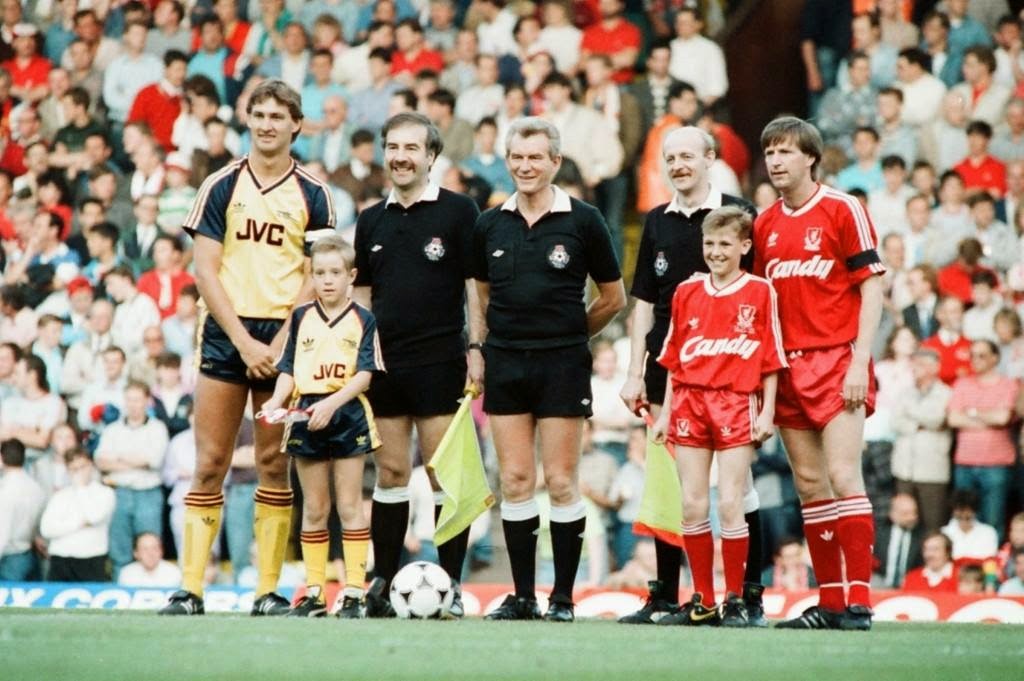 |
Tony Adams lines up at kick off with Liverpool captain, Ronny Whelan.
The Liverpool mascot was Manager, Kenny Dalglish's son, Paul. |
In the buildup to the game, Graham had told his Arsenal player's:
‘If we concede the first goal we’re finished. If we get in at half-time 0-0 we’ve won half the battle, and then we’ll have a chat at half-time and I fancy us to nick a goal in the second half. And if we do then it’s all about momentum, pressure gets to people. If we can score, the momentum will change and all the pressure then goes on Liverpool.”
Arsenal surprised Liverpool by playing a 3-5-1-1 formation, with an extra defender, to make three centre backs - Bould, Adams and O’Leary. This was a tactical masterstroke by the ever astute Graham, with Dixon and Winterburn pushed high up the pitch as fullbacks - Dixon deployed specifically to limit the ability of Liverpool’s creative driving force, John Barnes, in order to get forward and to dictate play.
Arsenal hurry and harass the Liverpool players, breaking up all attempts they make to dictate control and tempo of the game, with Rocastle and Thomas either side of the experienced Richardson, battling to win every ball and charging forward at every possible opportunity. Merson had been given a free role on the night behind Alan Smith to torment Liverpool.
Dixon and Winterburn are superb on the night, a constant threat to Liverpool’s flanks, sprinting forward time and time again to add width to the Arsenal attack - whilst never relinquishing their roles as defensive stalwarts.
After a tense first half, with few real chances, both sides go in at 0-0.
For Graham, so far at least, everything is going to plan. So far so good. The second half begins where the first had finished; with neither side asserting genuine control over the other. In the 52nd minute however, Arsenal win an indirect free kick, on the right hand side of the Liverpool box.
As Winterburn floats a teasing cross over the Liverpool backline, Alan Smith evades the offside trap and manages to connect with the most fleeting of glances, to guide the ball past Bruce Grobbelaar to make it 1-0 to Arsenal, and to complete personal double over Liverpool.
The Liverpool players are incensed and swarm round referee David Hutchinson, claiming that Smith made no contact with the header and that the goal was scored direct, via the free kick. After an anxious few moments for Arsenal whilst Hutchinson consults with the linesman, the goal is subsequently awarded - a decision vindicated by television replay evidence.
Arsenal now seem to grow in confidence after Smith’s goal, for the first time in the game they begin to play with a real pace and assuredness in possession. In the 70th minute, Merson finds space from midfield to put Thomas through one on one with Grobbelaar, but he snatches at the shot and his toe-poked effort is safely gathered by the Liverpool keeper.
As the match approaches the 90th minute, Arsenal pile forward in numbers, in search of the all precious second goal - leaving them vulnerable to the Liverpool counter.
In what appears to be the final moments, Liverpool break forward with substitute Peter Beardsley down the right hand side, who is soon joined by John Aldridge, on a lung busting run down the middle of the pitch, joining him in the attack. Beardsley cuts in from the flank and plays the ball square for Aldridge, who, unusually takes a disastrously heavy first touch. The ball runs free from his control before being collected harmlessly by the Arsenal keeper, John Lukic.
Moments later, Steve McMahon enacts one of the most iconic moments in English Football yelling to his team mates “One minute! One minute!”, whilst holding up his index finger to demonstrate the point. Liverpool are seconds away from being crowned Champions of England, once again.
 |
Steve McMahon gives his Liverpool teammates his ill-advised estimate on how Long they would
have to endure before once again being crowned Champions of England. |
Deep, deep into stoppage time, Lukic rolls the ball out to Dixon, who collects it and looks high up the field. He plays a superb long-ball up to the lone Smith, who has worked tirelessly all night. Smith controls the ball on his chest, turns, and with his left foot plays a wonderful ball through to the ever marauding Thomas.
“And its Thomas charging through the midfield. Its up for Grabs now”
 |
| Michael Thomas cooly stabs home the match winner surrounded by powerless Liverpool defenders. |
Thomas lifts the ball over Gary Ablett, but is then faced with the diving Steve Nichol. The ball ricochets back off the PFA Player of the year Nichol, and back into the path of Thomas. This time though, he makes no mistake in the one on one - nonchalantly toe poking the ball over a despairing Grobbelaar.
Its 2-0 to The Arsenal. Grahams masterplan has worked, and Arsenal are The Champions of England once again after a bitter eighteen year wait. In the space of just three seasons, Graham had created the most exciting young team in English football and fashioned them into Title winners, writing their names indelibly into the history of English football, it was, by every measure, a stunning achievement. Graham proved in '89 what Sir Alex Ferguson discovered with his fabled 'Class of '92' that you certainly can, by giving them the opportunity, win plenty with Kids. Arsenal celebrated their title win at Anfield that night in font of a Liverpool crowd who had not only stayed to see them receive the trophy, but had applauded them as they had done so. It seemed an appropriately sporting end to what had been a traumatic season for English Football. Here at Anfield at least on this occasion the best of English football was on display for all to see.
 |
| Arsenal's defensive triumvirate of Captain Tony Adams, Steve Bould and David O'Leary |
 |
| Match winner Michael Thomas and David Rocastle hold aloft The Championship Trophy. |
 |
| The Arsenal players celebrating on the Anfield Turf. |
The game at Anfield was a watermark in the history of English Football during an uncertain period in its existence, where the whole game and its infrastructure was quite literally “up for grabs.”
Sky TV was launched in Britain in February 1989, and the game at Anfield offered marketing and production executives a glimpse into the future. As the game captured the imagination of the British television audience (some 8.5 million homes tuned into the game), it was clear that a huge untapped reservoir of consumers existed, craving more televised live sport.
As Hillsborough cast a lasting shadow over the future of English Football, the impending findings of the Taylor report, with its recommendations for all-seater stadia, allied with the Sky-backed creation of The FA Premier league; vast sums of capital would soon be ploughed into English football - with, concomitantly, vast sums of capital to be made from it. If the game was “up for grabs”, then it was certainly Rupert Murdoch’s millions that grabbed it.
For Liverpool, it would mark the beginning of the end of their dominance of English Football. Despite reclaiming the league title a year later (to date the last time they have done so), fortress Anfield had been breached that night, and their realm of invincibility irrevocably destroyed.
For Arsenal, it ushered in the beginning of the most prolonged period of success in their history. A further league title was won under Graham in 1990-91, followed by a (then) unprecedented league and FA Cup double in ‘93, and the sensational victory over a superstar-laden Parma team in The Cup Winners Cup Final of ‘94.
 |
| Graham with The Championship trophy at Anfield, May 26th, 1989. |
Graham would leave Highbury in 1995, but his signings of Dixon, Winterburn and Bould, and youth players blooded in Adams, and later Ray Parlour, would go on to form the spine of the great title winning teams of the early Wenger Era.
Despite modern English football becoming unrecognisable from that night at Anfield, English football supporters have still experienced nothing like it since. Others will point to Sergio Aguero’s heroics against QPR in 2012 - and rightly so, it was a magnificent spectacle for the game.
But the exhibition of the two best, and most exciting teams in the country, facing off in a winner-takes-it-all showdown, in the final game of the season, with the less-than-fancied underdog prevailing at the home ground of the reigning champions - must surely take precedence over a team assembled costing hundreds of millions of pounds, against a team amounting to little more than relegation fodder, as indeed QPR were in 2012.
On that note, I shall wrap up with other notable success stories from English Football at the end of the 1988-89 season. The top two teams promoted from The Second Division were Champions Chelsea, and second placed Manchester City.
I wonder what ever happened to them...
 The season is back, and with it, comes Monday Night Football. The ultimate indulgence for those who consider football with an air of intelligence in debate. With two absolute footballing heavyweights - in the form of Liverpool and Manchester United legends Jamie Carragher and Gary Neville, sitting on the panel, the Sky punditry line up is probably the best in world football right now.


